Thursday, May 14, 2015

Briar Queen News!

Look who's on the banner at the RT Booklovers Convention!
(That's Briar Queen, third book in)

(And, in case you're wondering, the sloth the Harper Voyager girl is holding is named Nova.)

Wednesday, May 13, 2015

Fantastic Faery Books

In honor of Briar Queen's June 2 release, here are my favorite books about faeries:

STORIES

MOONHEART-Charles de lint

THE WAR FOR THE OAKS-Emma Bull

INK AND STEEL/HELL AND EARTH-Elizabeth Baer

THE HALLOWMERE SERIES-Tiffany Trent


DAUGHTER OF HOUNDS/ALABASTER-Caitlin R. Kiernan

TITHE, VALIANT, IRONSIDE/THE DARKEST PART OF THE FOREST-Holly Black

THE WICKED LOVELY SERIES-Melissa Marr

LITTLE BIG-John Crowley

MOONWISE/CLOUD AND ASHES-Greer Gilman

LAMENT/BALLAD-Maggie Stiefvater

EXCEPT THE QUEEN-Jane Yolen and Midori Snyder

THE TREE OF SWORDS AND JEWELS/THE DREAMSTONE-C.J. Cherryh

FIRE AND HEMLOCK-Dianna Wynne Jones

THE MYSTERIES-Lisa Tuttle

THE STOLEN-Bishop O'Connell

PETER PAN-J.M. Barrie

THE PERILOUS GARD-Elizabeth Marie Pope

THE REPLACEMENT-Brenna Yovanoff

TAM LIN-Pamela Dean

THOMAS THE RHYMER-Ellen Kushner

THE HOUND AND THE FALCON-Judith Tarr

RESEARCH

FAERIES (Deluxe edition) Brian Froud

BAD FAERIES, GOOD FAERIES-Brian Froud and Terri Windling

THE FAERY COMPANION-Beatrice Phillpotts

THE GREAT ENCYCLOPEDIA OF FAERIES-Pierre Dubois

THE ULTIMATE FAERIES HANDBOOK-Susannah Marriott

AT THE BOTTOM OF THE GARDEN-Diane Purkiss

THE FAERY PAINTINGS OF MAXINE GADD-Maxine Gadd

THE BOOK OF FAERIES-Francis Melville

THE SECRET LIVES OF ELVES AND FAERIES-John Matthews

THE ELEMENT ENCYCLOPEDIA OF FAIRIES-Lucy Cooper

THE FAIRY FAITH IN CELTIC COUNTRIES-W.Y. Evans-Wentz

ABBEY LUBBERS, BANSHEES, AND BOGGARTS-Katharine Briggs

THE ART OF AMY BROWN I and II-Amy Brown


VISIONS AND BELIEFS IN THE WEST OF IRELAND-Lady Gregory

Thursday, May 7, 2015

Once Upon A Rhyme by Jack Heckel

Welcome, Jack Heckel, who is actually John Peck and Harry Heckel, http://www.jackheckel.com/ , authors of Once Upon A Rhyme to It's All About Story.


1) Describe your book Once Upon A Rhyme in one paragraph.

Once Upon A Rhyme is all about what happens when a fairy tale goes wrong. For his entire life, Prince Charming has known that he would slay the Great Wyrm of the south, rescue Princess Gwendolyn Mostfair, marry her and live happily ever after. However, when the dragon accidentally impales herself on Will Pickett's pitchfork, and Will convinces his sister, Liz, to let him go rescue the princess, everything goes wrong. It's a comedic fairy tale fantasy about what happens when life doesn't turn out the way we thought.

2) What inspired Once Upon A Rhyme?

John had the original idea. It started with a simple question. Who is Prince Charming? Who is this guy who shows up in a plethora of fairy tales, has great hair, a fine steed and gets to bestow true love's kiss on any number of princesses? We wanted to see what would happen if his fairy tale didn't go as planned. Originally, it was going to be a tragedy, but Harry interpreted it as a comedy. Once that happened, we decided to write it.

3) Is this your first work of fiction?

For John, yes. For Harry, no. Harry's written two novels with another author under the pen name Lee Lightner, Sons of Fenris and Wolf's Honour, set in the Warhammer 40k universe. He's also had three small press novels, In the Service of the King (A Crimson Hawks Adventure), Souls of the Everwood and Balefire and Brimstone in addition to numerous roleplaying game books.

4) What song or music piece would you put on a soundtrack for Once Upon A Rhyme?

That's hard to say. We both listen to music when we write. For The Charming Tales, John listens to any 80's power ballad. After all, Charming's a rock star. Harry listens to the soundtrack to The Princess Bride while writing our fairy tales.

5) Which character was easy to write? Which was the most difficult?

The easiest character to write was probably Prince Charming because he has such an ego that he practically writes himself. We just have to imagine a man mentally composing an epic poem about himself while considering whether the color of his hose means he should have lace on his cuffs or not, and we are there. He's delightfully absurd.

The most difficult character to write was also our favorite by the end, Princes Gwendolyn. She's not who she appears at first and carries a dark secret. While she's ostensibly the villain of the piece, she's also a victim who was left by her love to rot in a dragon's clutches for decades. She contains both darkness and light, and she was a pleasure to explore.

6) What is your writing space like? Or can you write anywhere?

If either of us are within reach of our laptops, we can write. We both have day jobs that keep us busy and families who we adore. We have to take advantage of any time we can find, regardless of whether we are traveling across the country or finding some quiet time in our car during lunch.

7) Any odd writing habits?

Collaboration is odd. We create together and support each other. We argue and debate. We finish each other's sentences. When we write, one person finishes a chapter and then the other person rewrites it. It's a bit humbling and challenging to do that, and it takes a lot of trust. That's probably the strangest part.

8) Do you outline?

Definitely. We can't work on a book without an outline. Otherwise, since we collaborate, we'd be stepping all over each other. Having said that, our outlines usually only survive until about Chapter 4, as by that time, the characters have taken over. So, we redo the outline again and again. By the end, our outlines have been revised multiple times.

9) What is your favorite fairy tale?

John's favorite is The Seven Ravens. It isn't among the pantheon of Cinderella or Snow White or Beauty and the Beast, so it may be unfamiliar to most people. It is the story of a girl who takes up a quest to rescue her brothers, who have been cursed to live as ravens. It is an unusual story because the girl goes on her quest entirely alone and unaided. It is also unusual in that it lacks the presence in even a peripheral way of a romantic interest for our heroine.

Harry's a bit more indecisive, being torn between the more traditional Snow White and Sleeping Beauty, and claiming that Matt Smith's first season as Doctor Who may be his favorite fairy tale. However, we both hold a special place for The Bluebird which is the first fairy tale in which there is a reference to Prince Charming.

10) What is your favorite fictional world, one you'd want to visit?

No question or debate here. We both want to visit Middle-Earth. There are other worlds with incredible complexity and detail, but for both of us, we would want to step out of Bilbo's house and follow the road as it goes ever, ever on. We'd want to see Mount Doom and admire the wonders of the Elves. We'd like to stand next to the tree of Gondor and delve deep below the earth to the Mines of Moria. There's really no place that has captured our imagination like Middle-Earth.

11) What is the best writing advice you've ever received?

For Harry, it's this: don't leave the keyboard without knowing what you are going to write next. His mentor, Daniel Greenberg, told him that you come back to the keyboard in the same place you left. If you were frustrated and didn't know where to go, that's what you'd confront when you returned. Always leave before you are too tired and have run out of ideas. It's always hardest getting started.

For John, it was something Harry said. Don't try to write the perfect sentence. It's easy to get hung up trying to create the ultimate prose or striving for perfection. The worst completed work can be edited. The best first paragraph without the rest of a novel to go with it is only a first paragraph.

One last thing we'd like to include are the immortal words of Weird Al Yankovic - dare to be stupid.

12) In Once Upon A Rhyme, are there any hidden acknowledgements to friends, places you've lived, favorite writers etc;

Probably. We certainly have fairy tale references throughout, and we try to heap love on fairy tales. The one place that we both remember having hidden references are in several guards in the sequel Happily Never After, who are named after university friends.

13) Can you tell us what we have to look forward to in the sequel to Once Upon A Rhyme?

The good news is that the sequel, Happily Never After, is already available. It brings our story arc to a conclusion with the climactic wedding of Princess Gwendolyn, as well as the introduction of the Seven Players, a group of dwarfs (or is it dwarves?) and of course, Charming himself. It was originally meant to be the second half of Once Upon A Rhyme, and Harper will be publishing them together in a Fairy-tale Ending, later this summer.

If that wasn't enough, we've recently finished the third book in The Charming Tales, Pitchfork of Destiny. Without giving away too many spoilers, the Great Dragon of the North, Volthraxus, the Killing Wind, finally musters up enough courage to go tell Magdela, the Great Wyrm of the South, his true feelings for her. When he learns from Beo (a wolf) that she was killed, he turns his wrath toward the man responsible--Will Pickett. That means that Will has to face a living fire-breathing dragon, and he believes only Charming can help him. While those two quest for the dragon, Liz comes face to face with the man everyone else believes will save the kingdom, a mysterious figure known as the Dracomancer. By the end, fairy tales are fractured, and hopefully, there will be a lot of amusement for our readers.

Thank you!

Once Upon A Rhyme and Happily Never After are both available on Amazon:  http://www.amazon.com/Jack-Heckel/e/B00L0E1CO8/ref=ntt_athr_dp_pel_1

Tuesday, April 21, 2015

Movie Wish: A Buffy Revamp

So Joss Whedon's still wrapped up with the Avengers, but some of us are still hoping he'll return to the Buffyverse. Here's who I'd think make the perfect movie cast.


BUFFY: Chloe Grace Moretz

XANDER: Ansel Elgort

WILLOW: Maisie Williams

SPIKE: Jamie Campbell-Bower

ANGEL: Theo James

FAITH: Adelaide Kane


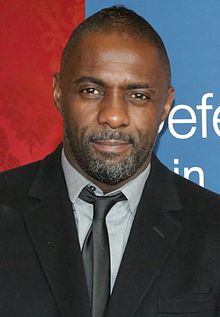
Giles: Idris Elba

Agree? Disagree? Who would you add?

Tuesday, April 7, 2015

Erik Buchanan Author of True Magics

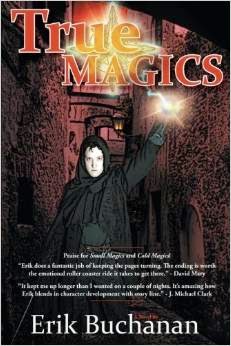
Welcome Erik Buchanan, author of True Magics (March 17, 2015 Dragon Moon Press) http://erikbuchanan.blogspot.com/2015/03/new-true-magics-is-out.html  to It's All About Story.


1) Describe True Magics in one paragraph.

True Magics is the third book of the Thomas Flarety stories. Set in a Renaissance-era world where magic is nearly non-existent, these books tell of Thomas's discovery of magic and the consequences that come from it. In True Magics, Thomas and his friends are recovering from fighting in a war in the north and are attempting to make Eileen the first girl to attend the Royal Academy in 200 years. Everything changes, though, when stories of Thomas's magic reach Hawksmouth. Suddenly, Thomas's friends start disappearing. The king orders Thomas to hide his magic and find the other magicians in the city. The Cult of the Daughter wants Thomas to join them. The Archbishop of the High Father wants Thomas to surrender to the Inquisitors and redeem his soul. Preachers are raging in the streets against witchcraft, the Academy, and the King. The city itself is falling into chaos, and it's up to Thomas to find a way to fix things before the struggle between the king and the Archbishop turns into an all-out war that will destroy everyone and everything he loves.

2) What inspired True Magics?

True Magics is the third book in the series, so part of the inspiration was to finish telling the story! It was also inspired by a lot of stories of survivors of war trying to put their lives back together, and by the struggles of individuals with differences in societies that do not accept them.
Also, once you've written two books about fantasy characters, you really have to write a trilogy or the other writers make fun of you (Joke. Mostly).

3) Is there a specific way magic is depicted?

In this world, my magic is depicted as rare and small. It's also really despised by the church and called witchcraft by those who don't like it. Our hero's magic is greater than most because of the events that happened in Small Magics and in this book he needs to understand the true nature of magic if he's going to survive.

4) Is this your first work of fiction?

This is my third published novel and the eighth I've written. I have published two other novels (Small Magics and Cold Magics) in this series and have written three more under my own name: My first novel (which will never see the light of day), another one that I intend to revise and self-publish in the near future, and a new one that I am happy to start shopping out to publishers in the next couple of months. I've also ghostwritten two other novels.

5) What song or music piece would you put on a soundtrack for True Magics?

Anything by the Chieftains, as that's the music I mostly used when I was writing it. Boil the Breakfast Early is  a favorite.

6) Which character was easy to write? Which was the most difficult?

The most difficult was probably Thomas, our lead, because he goes through a lot of changes in this book and I wanted those to read as real and not contrived. The easiest was probably Henry, because he's fun in a very dangerous kind of way.

7) What is your writing space like? Or can you write anywhere?

I can write anywhere, but I'm usually at my kitchen table, facing the wall that has my whiteboard, calendar, and project list to keep me on track.

8) Any odd writing habits?

Not sure if it's odd, but I have a terrible time writing when there's an internet connection, so I use a program called "Antisocial", which blocks access to social media and to whatever other sites I find myself browsing when I should be working.

9) Do you outline?

I do now. True Magics is the last book I wrote without an outline. Since I started ghostwriting and since I made the decision to make my living solely from my writing, I've found the need for speed has taken over and I no longer have the luxury of exploring my characters during my writing process. Now I do those explorations in the outline, so I don't have to re-write hundreds of pages if something goes awry in my books.

10) What is your favorite fairy tale, myth, or folk tale?

The Odyssey by Homer. It's a wonderful adventure.

11) What is your favorite ficitonal world, one you'd want to visit?

My current favorite is the world in Patrick Rothfuss's King Killer Chronicles. As for which to visit, I want to visit all of them (except for the world of Game of Thrones, because really those folks are mean), but I'd probably start with the Shire in The Hobbit, because I could use a vacation someplace quiet.

12) What is the best writing advice you've ever received?

From the fine author Douglas Smith: "Bum in chair, fingers on keyboard, cursor moving to the left."
Also Stephen King's On Writing is a great read for anyone trying to produce popular fiction.

13) In True Magics, are there any hidden acknowledgements to friends, places you've lived, favorite writers, etc;

Not really, though the weather is a tribute to the springs I remember from my childhood in Nova Scotia.

14) Can you tell us what we have to look forward to after True Magics?

Right now I'm working on a horror/humor novel tentatively titled The Forces of Darkness vs. Bill Righthands Construction and Restoration, which I am hoping to self-publish before the end of the year. I am also shopping around a new YA horror series set in Victorian London, and working on several short stories as well.

Thank you!


Purchase True Magics here: http://www.amazon.com/gp/product/1897492847/ref=as_li_tl?ie=UTF8&camp=1789&creative=390957&creativeASIN=1897492847&linkCode=as2&tag=wwwdragonmo07-20&linkId=FVHYWCUG6PELEIKY


Friday, March 20, 2015

Tim Lees Author of The God Hunter

Welcome, Tim Lees, author of The God Hunter (Harper Voyager Impulse) (https://timlees.wordpress.com/2014/06/13/the-god-hunter/) to It's All About Story.


1) Describe The God Hunter in one paragraph.

This is my elevator pitch is it?
Fossil fuel is running out. But imagine you could mine the psychic energy deposited in churches and other sacred spots, converting it to electricity? That's what Chris Copeland and the Registry Field Ops do. Unfortunately, that energy tends to have a mind of its own, and when one of Chris's operations goes horribly wrong, the consequences will haunt him for years--all the way from Hungary, through London and New York, to the American Midwest.

2)What inspired The God Hunter? What was your inspiration for the gods?

The whole thing came to me very quickly. I noticed a book in my (now) wife's bookcase called Ghost Hunters. It's hardly an unusual title, but for some reason a story just jumped into my head. Still, ghosts have been done to death (ho ho), so I upped the ante a bit by combining it with a concept from my first ever published story, one I've been meaning to return to for years. I wrote the first few chapters in a great rush, sitting under a statue of Joe Dimaggio. (The weather was a bit better then than it is today. As I write this, snow is piled in great grey slag-heaps everywhere you look, and the Chicago winter is doing its best to freeze my knee-caps off. But I digress...)

3)Is this your first work of fiction?

Not by a long way! I've published a fair amount of short fiction--anyone who's interested can track down the e-book collection News from Unknown Countries on Amazon--and the novel Frankenstein's Prescription (Tartarus Press). It's mostly pretty weird.

4)What song or music piece would you put on a soundtrack for The God Hunter?

I've never thought about that! But I think Miles Davis in his Bitches Brew phase might have been pretty good--mysterious, occasionally creepy, and with that kind of abstract, half-glimpsed quality I tried to suggest for some of the gods in the book.

5)Which character was easy to write? Which was the most difficult?

I loved writing Anna Ganz, the foul-mouthed Hungarian detective. She was great fun--feisty, driven, and under-appreciated by her bosses, but with a great sense of justice. I have some interest in the ways people cope with difficult and dangerous jobs--which is one of the things the Field Ops books are about, I suppose--and it was fascinating to watch her gradually reveal her inner self. She seemed to have come from somewhere else, rather than been made up for the purposes of the story.
Conversely, I find the hardest characters to write are the minor ones--someone glimpsed in one paragraph, who needs to be fleshed out with a single line but mustn't intrude too much on the general narrative. My editor pointed out some of my lazier attempts to do this and made me rewrite. It was like being back in school.

6) What is your writing space like? Or can you write anywhere?

When I'm alone in the apartment I just sit in the main room, and am very, very easily distracted. Now, distraction is a necessary thing for writers--often the mind will provide an answer to a problem while the writer's looking elsewhere--but there are times you just have to knuckle down and do your job.
If I'm doing first drafts, or revising from a print-out, I'll often go and sit in a cafe. If it's a first draft, I often have no real notion what I've written until I read it back later. Sometimes, I've been surprised, and I like that.

7)Any odd writing habits?

Writing is a pretty odd habit in itself, isn't it?

8)Do you outline?

Ideally, I outline in my head. The God Hunter and my previous novel, Frankenstein's Prescription, both came to me pretty much whole, at least in terms of general structure. The new novel, Devil in the Wires, wasn't like that. I had some vague notions, but they changed part way through--a minor character took on more significance, and it became clear that, rather than the three interlinked stories I had planned, there was a single narrative struggling to get written. Which, eventually, it did, and the book is much stronger as a result.
I have this weird idea that these books already exist, and I am simply trying to unearth them, like some sort of literary archaeologist. If I do it well, I'll have a good book. If I don't...well. Let's not think about that.

9)What is your favorite fairy tale, myth, or folk tale?

As a kid I was fascinated by the Trojan War. I still find the story of Odysseus intriguing--he's supposedly the first character in literature to have a completely random physical characteristic (short legs), and is therefore a precursor of more modern "realistic" narrative, perhaps. Interestingly, when I read the Odyssey, I found it was mostly a naturalistic piece, and the fantasy elements that everyone knows--the Cyclops, etc--are embedded in it as a kind of boast or tall tale, so there's a suggestion old Odysseus may have just been making it all up.
The character of Odin or Woden is also intriguing, in his aspect as a magic-maker and seeker after wisdom. He hung on the tree for three days and three nights, Odin sacrificed to Odin. That sounds a little like another figure many people still believe in today. It's fascinating how these themes repeat themselves in all cultures, at all times.

10)What is your favorite fictional world, one you'd want to visit?

The last clause rules out most of the ones I've read about. However, Ballard's Vermillion Sands has always seemed appealing: decadent, run-down, surreal, a place where you can be lovesick and unhappy in enormous comfort. I could go for that.

11)What is the best writing advice you've ever received?

"Don't."
I didn't listen.

12)In The God Hunter, are there any hidden acknowledgements to friends, places you've lived, favorite writers, etc;

I think a lot of things just crept in accidentally. I was pretty much improvising most of the way through, with an overall story mapped out in my head. The result was that, when I needed a name, or a character trait, I just reached out and grabbed whatever came to mind. I apologize to anyone who may have been horribly misused thereby.
Len Deighton's early spy thrillers were an influence. That's where the humor came from, and the collision between fantastic adventure and the utterly mundane. I like the idea that my hero is, essentially, an employee. He's not Superman or Indiana Jones, he's just doing his job. Of course, by the end of the book he's had to do a lot more, too, but that's not where he starts out.

13)Can you tell us what we have to look forward to after The God Hunter?


The second Field Ops novel, Devil in the Wires, is due out in May. It follows on chronologically from The God Hunter but I've made sure new readers will be told all they need to know to enjoy it, so it's really a stand-alone sequel. The itinerary for this one is Iraq, Paris, London, and Chicago.
And I should give a plug to C2E2, the Chicago Comics and Entertainment Event. Friday, April 24th, I'm on a panel with the excellent Lexie Dunne discussing "gallows humor". Anyone know any good jokes?

Thank you!


Monday, March 9, 2015

About a Cat


Two years ago, Pooka, a little black thing hiding under the nearest car in my apartment complex, found me. I began feeding him, but he stayed wary. After he ended up on my doorstep bleeding and ragged from a cat attack, I took him to the nearest vet and adopted him.
He was the perfect little gentleman when he wasn't being a wild thing. Even when he was sick, he'd totter to the litter box. He was stubborn, affectionate, and only had to be told once not to jump up on something. He liked to go outside, still, and roam, and I didn't have the heart to refuse him. At night, he'd strut around the apartment with his tail in the air.
He was more like a little fairy thing than a cat. I remember looking out the window during a full moon one night and seeing him sitting in the parking lot as three rabbits hopped toward him. Two went past, but the first touched noses with him before moving on. And he sometimes reminded me of a black fox.
He wasn't only my little buddy, he was also my good luck charm.
A week after I officially adopted Pooka, 7 days exactly, I was contacted by Harper Voyager. I had entered an open submissions call and two days later, I had an agent and a three-book deal. Coincidence? I think not.
I'll miss my little buddy, who was only with me for two years before lung cancer took him in three days. He had to be euthanized, because there was no hope of treatment and he couldn't breathe or eat, even though, that morning, he determinedly trotted after me. He fell asleep in my arms, knowing that I loved him.